Kitsoft CEO Oleksandr Iefremov gave an in-depth interview to dev.ua about how Ukrainian GovTech is evolving and how the approach to building digital public services is changing along with it.
The conversation covered the decision to open-source Liquio and develop a partner ecosystem around the platform, Kitsoft’s expansion into international markets, a new model for building government digital systems, the use of AI, and cybersecurity.
We have gathered the key points from the conversation.
Open-source Liquio and a new model for scaling
One of the key topics of the interview was Kitsoft’s decision to open-source its low-code platform Liquio.
According to Oleksandr, as AI advances, owning the code itself is gradually losing commercial value, as algorithms and software solutions are becoming easier to replicate. At the same time, opening Liquio makes it possible to develop a broader partner ecosystem around the technology.
“Along with opening the code, we also began actively training and certifying specialists in Liquio. In other words, this has become a full-fledged partnership model.”
Today, 12 teams work with Liquio, including nine private companies. For specialists in different roles, Kitsoft offers dedicated training programs that combine online courses, video lessons, and personal mentoring.
The model allows partners to work with the technology independently and build services on top of it, while Kitsoft contributes as a technology expert.
“When you enter a market with open technology and make it clear from the outset that your goal is to train local teams and develop digital systems together with them, the open-source model gives you far more opportunities for growth than the local financial losses it may entail. The larger the ecosystem around Liquio, the more opportunities there are for us.”
From Belgium to African countries
Kitsoft also uses this approach to expand into international markets. Today, the company has offices in Brussels and Berlin and has established a dedicated French-speaking team to work with Francophone African countries.
One of its international projects already in operation is BelDoc in Belgium, built on Liquio. The service enables businesses to be registered online. Kitsoft is also working on several pilot projects with German cities.
In Africa, Oleksandr describes the company’s work in Côte d’Ivoire as its largest project, where Kitsoft is working with a local state corporation. The team is involved in deploying Liquio, training local specialists, and helping to build the first package of digital services.
There are also several international pilot projects with ITU and the World Bank. Kitsoft is also beginning cooperation and running similar projects with African countries, including Mauritania, Senegal, and Nigeria.
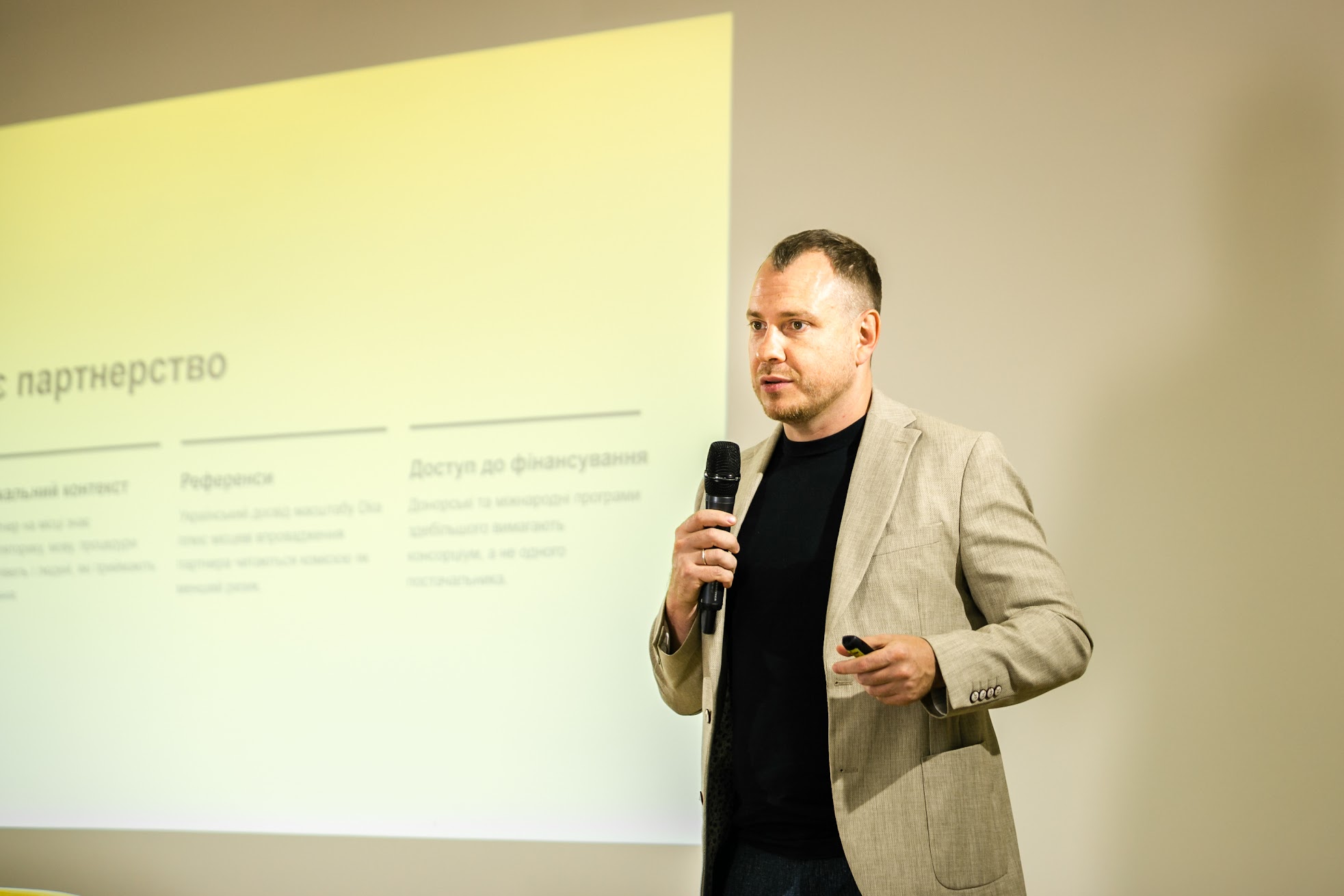
“Overall, we currently have around 15 countries on our radar. They are all at different stages of development, but they are moving in the same direction: digitising processes, making life easier for citizens and businesses, improving government efficiency, and strengthening the economy. Everywhere, we see the same challenges and problems that Ukraine once faced: dispersed systems, fragmentation, and vendor lock-in. None of this is unique to us: both more developed and less developed countries face the same problems,”
says Oleksandr Iefremov.
Obrii: technology and expertise remain with the government
Another example of the new GovTech model discussed in the interview is Obrii, the labour market ecosystem in Ukraine.
As the Liquio implementer, Kitsoft created the technological foundation: it helped shape the solution architecture, deployed production and testing environments on the infrastructure of the State Employment Center, configured the infrastructure, and transferred full control over it to the client.
The team also trained 10 specialists who will continue working with Obrii. They completed a 120-hour Liquio training course. Other companies involved in the project have also received training from Kitsoft.
“This is a test of a fundamentally different approach, where a government team receives not only a ready-made system but also the technology and its own expertise, enabling it to continue developing the system independently.”
Training teams has also become part of the Liquio scaling model beyond Ukraine. Kitsoft runs hands-on workshops where teams work with mentors to build digital services. Such projects have already taken place in Montenegro and Mauritania, while training is currently underway in Côte d’Ivoire.
State Online Gambling Monitoring System: real-time market monitoring
In the interview, Oleksandr also spoke about the State Online Gambling Monitoring System, which Kitsoft is developing on Liquio.
The team developed the first phase of the system in 2.5 months. It collects information on bets, winnings payouts, refunds, and other financial transactions in real time. The system’s architecture is designed to handle up to 100,000 operations per second.
As of August, 28 of the 31 licensed gambling operators had integrated with the system.
The second phase is expected to expand monitoring to cover the entire gaming cycle, including game results, the use of credits and tokens, and RTP indicators. At the same time, the system does not collect players’ personal data: transaction information is transmitted in anonymised form.
AI in building digital public services
Another topic of the conversation was the development of AI tools in Liquio.
Today, AI is already part of the technology used to build services. Liquio Builder can transform a formalised technical specification into the initial structure of a future service and generate forms. Copilot helps low-code developers configure and modify processes, providing examples and templates. Assistant enables users to work with Liquio documentation and its knowledge base in real time.
Kitsoft is also developing MCP integration to automate low-code development, the preparation and review of technical project documentation, routine operations, and test-case generation.
The Kitsoft team was involved in creating Diia.AI, the AI assistant on the Diia portal.
“Overall, by our estimate, we have increased the speed of our low-code developers’ work by an average of 40% when using AI. And we have no intention of stopping there.”
Cybersecurity amid constant attacks
In the interview, Oleksandr also discussed Kitsoft’s approach to the cybersecurity of government digital systems operating under constant cyberattacks.
Security is integrated directly into the development process. The team uses code checks, static and dynamic analysis, scans infrastructure, and monitors anomalous behaviour. At the architectural level, the zero-trust principle is applied.
Liquio also supports an architecture in which different levels of protected data can be stored in separate segments.
“We have integrated security into the development process. At this stage, we already use code checks, static and dynamic analysers, scan infrastructure, and monitor anomalous behaviour.”
Kitsoft is ISO 27001 certified, while Liquio has received a certificate from Ukraine’s State Service of Special Communications and Information Protection with a G2 assurance level. The company has also established its own Security Operations Center (SOC) for continuous threat monitoring and cyber incident response.
Read Oleksandr Iefremov’s full interview on the evolution of Ukrainian GovTech, the State Online Gambling Monitoring System, Kitsoft’s international projects, AI, the labour market, and other topics on dev.ua.