Kitsoft has created over 200 solutions for the government, including the Diia portal and services in “Kyiv Digital”. Now the company is scaling its own low-code platform, Liquio, in the EU and African markets. In a conversation with LIGA.net, Kitsoft CEO Oleksandr Iefremov spoke about the creation of Liquio, the platform’s capabilities, AI integration, and the company’s international plans.
About Liquio and its capabilities
Liquio is a platform created by the Kitsoft team for the rapid launch of governmental digital services. It combines modern architecture and integration with artificial intelligence. The platform allows quick configuration of business process logic, making changes, and scaling solutions without modifying the code. Thanks to this, new services can be launched in just 4–6 weeks and withstand extremely high loads.
Liquio offers a wide range of functionality that covers key types of public services:
Portal solutions. These are scenarios for submitting applications for any public service. In some cases, the process can be fully automated, when an application isn’t even reviewed by a human — as in the case of opening a sole proprietorship (FOP) through Diia.
Case management. This involves working with a “file” of data about a person or legal entity, based on which a decision is made — for example, about issuing a permit. This process can also be built on Liquio.
State registers. Unlike a regular database, a register does not contain copies of paper documents — it is the source of official information.
These are the three main areas of functionality, but not the only ones. For example, the platform can also be used to create mobile applications.
Low-code reduces development costs
To create a single product on Liquio, one business analyst (or product owner), 1–2 low-code developers (Kitsoft often hires specialists at the trainee level and trains them within the company), one QA, and a project manager are usually sufficient. On average, a product that would take from six months to a year in classical development is implemented on Liquio in about a month and a half.
To start working with the platform, basic knowledge of JavaScript is sufficient. Trainee developers can already take on small tasks and bring practical value by the second week. And within three months, they fully acquire the necessary skills to work with the platform.
 Image: The Kitsoft team presented the low-code platform Liquio at the Global DPI Summit in South Africa
Products created on Liquio
More than 200 solutions have now been implemented on Liquio. The most well-known and significant project is the Diia web portal.
Kitsoft also developed services for Kyiv’s digital services ecosystem “Kyiv Digital”: the backend for some mobile services and the internal processes for delivering municipal services.
Another important project is the veterans’ register and services to support them, such as “The path of the wounded”. This project has increased cybersecurity requirements, so the Kitsoft team implemented additional layers of protection. The veterans’ register was also integrated with Diia.
The company is currently working on the Playcity project — the first stage of an online gambling monitoring system, which aims to provide the state with a real reflection of operators’ activities and transparency in tax payments. It is a very large system with high requirements for the number of transactions.
About AI integration in Liquio
Liquio has built-in AI tools that help make the process of creating services even faster, more flexible, and smarter.
AI Builder. A service that generates forms based on a textual description. There are certain requirements for the structure of the description, but it is not code — rather a technical specification created by a business analyst.
Copilot based on Gemini. A tool that suggests code options taking into account the context of the programming language and the project’s internal documents — for example, regulatory acts on which the service is based.
AI Assistant. Helps navigate the architecture and structure of Liquio, as well as the component library.
AI usage opportunities for customers
In cooperation with the Ministry of Digital Transformation, the Kitsoft team this year implemented the Diia.AI solution. On the ministry’s side, there was model fine-tuning and connection to it. On the Kitsoft side — calling services, that is, the MCP protocol (an analogue of an API for AI agents). Already now, through Diia.AI, one can request the Income Statement service, and the list of services is gradually expanding.
The company is also developing a solution that will help civil servants enter information into the system more quickly. This includes scanning documents (both printed and handwritten) and audio transcription. Accordingly, if a person applies for a service at an Administrative Service Center, these tools will help assist them faster.
There are plans to provide clients with a mechanism for managing the data on which the AI is trained, so that a system administrator can independently choose what the AI assistant will know and what it will not.
Confidentiality in AI integration
When working with AI in Liquio, data filtering and full depersonalization are applied.
No personal identifiers are transferred to the AI, only the essence of the request: for example, a person wants to start a business and needs information on how to do it.
says Oleksandr Iefremov, CEO of Kitsoft.
Only generalized information is sent to the model, without any specific personal details. And after receiving the response from the AI, the system locally reinserts the relevant personal data into it.
International expansion of Kitsoft
Kitsoft has opened a subsidiary in Brussels, BellDoc, and its team has already implemented the digitalization of the LLC registration process in Belgium.
The team is currently in the final stage of negotiations with several African countries that want to digitalize services.
This year, the company also opened an office in Berlin — Kitsoft Germany. In Germany, the company sees significant potential: it is a large and developed market with numerous municipalities, substantial budgets, and a growing interest in GovTech solutions.
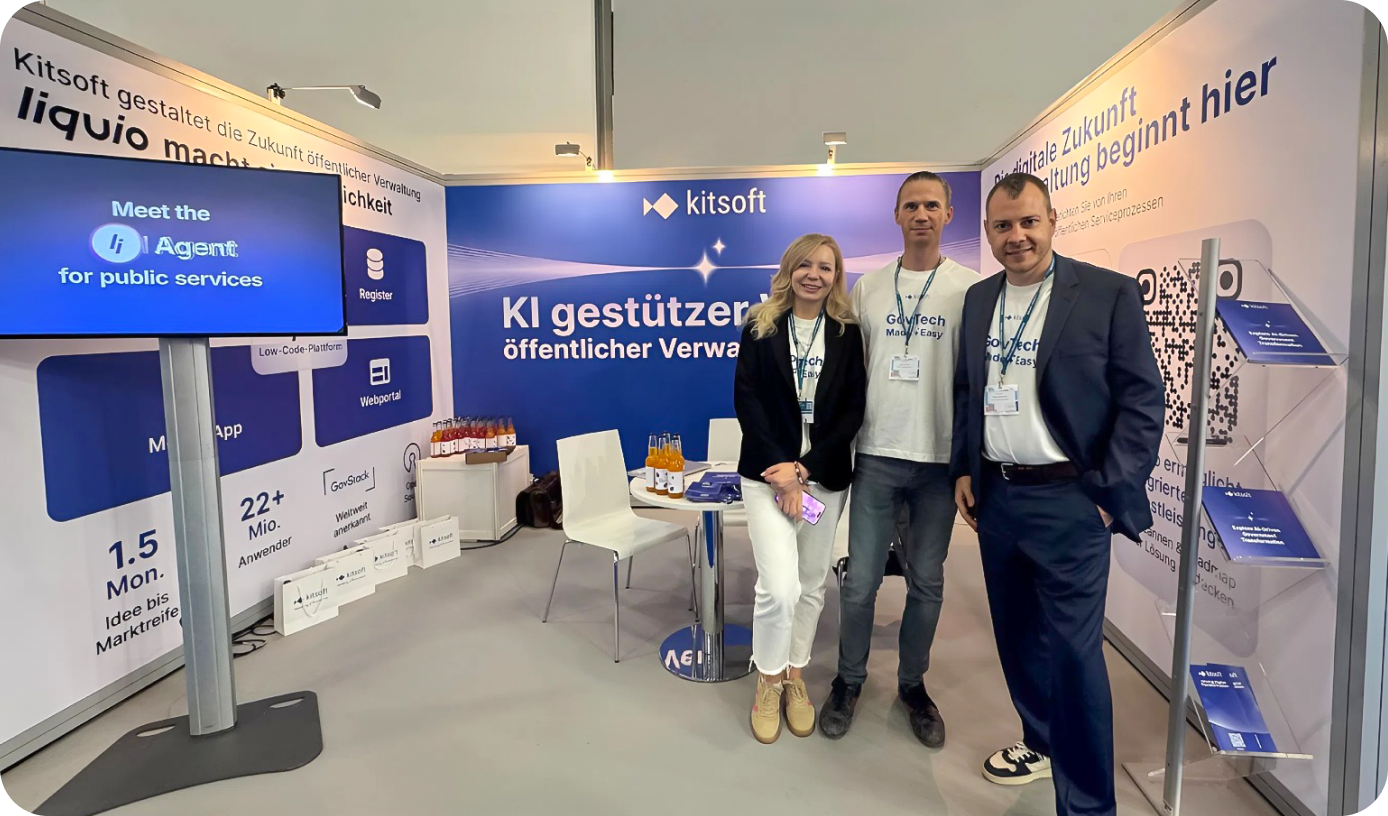 Image: The Kitsoft team at the Smart Country Convention in Berlin
We do not compete with solution providers — there are plenty of them in local markets. Instead, we want to help them by providing a tool for faster digitalization and product launches.
notes Oleksandr Iefremov, CEO of Kitsoft.