Today, a new paradigm is rapidly emerging in the world — the digital sovereignty of states. After years of dependence on closed commercial ecosystems, governments strive to own their data independently, create open technologies, and control critical digital infrastructure. At international summits, digital sovereignty today stands alongside AI and cybersecurity — it is no longer only a matter of technology, but also of the digital independence of states.
In an article for DOU, Volodymyr Sichka, CTO of Kitsoft, shared experience in creating the low-code platform Liquio, which the Kitsoft team is developing with consideration of approaches to digital sovereignty. He also spoke about the AI tools used to accelerate the development of public services.
It is Liquio that underpins the Diia portal and a number of its key services — eBaby, uResidency, e-Entrepreneur, and others. This year, together with the Ministry of Digital Transformation of Ukraine, Kitsoft also launched the AI assistant in Diia — the first in the world to enable receiving a public service in a chat.
 Image: Volodymyr Sichka, CTO of Kitsoft
Why we chose the path of building our own low-code platform
In 2019, we faced a choice: continue creating digital public services in the traditional way — through backend and frontend developers — or try to develop our own low-code platform that would allow us to deliver solutions faster and at scale. The idea of using an existing platform was quickly dismissed after thorough analysis: the available solutions were either not fully low-code or poorly adapted to the specifics of GovTech — especially the Ukrainian context. We saw the growth of the GovTech market and understood that building our own platform was a risk, but also a strategic opportunity. This is how the story of Liquio began, although at that time it did not even have this name.
We immediately set out to create a full-fledged solution: a user workspace, business process automation in BPMN format, internal registries, a file storage system, connectors to external resources, and many other components. The main principle was simple but ambitious: any client request that was repeated or had potential for scaling, we implemented not as a separate feature but as an extension of the platform itself. This took more time than point solutions, but created a long-term effect — the functionality we built could be reused for new services without additional development. We clearly understood how to best evolve the platform, because from the very beginning we were building it around the real needs of public services.
Scaling without code
Over time, the platform became increasingly mature and functional. We gradually reduced the involvement of traditional backend and frontend specialists in the development of new services and instead created a new role — low-code developers. These are specialists who build public online services without writing code from scratch: they model business processes in BPMN format, configure integrations between systems, and define the logic for processing applications and user interaction scenarios.
Since such specialists practically did not exist on the market, we developed our own training and development system. It includes internal courses, a knowledge base for quick onboarding of new developers, and a grading system — from Trainee to Senior. This made it possible to rapidly scale teams and maintain consistent quality even with a large number of projects. We also formed special teams — “Streams,” which launch individual projects on the platform. Each Stream is a small autonomous team consisting of a project manager (PM), a business analyst (BA), several low-code developers, and a QA specialist, who together take full responsibility for the result.
This model allowed us to significantly accelerate the development of public services and reduce the workload on traditional developers. But most importantly, it enhances value for clients: every new improvement or extension of Liquio automatically becomes available to all projects running on the platform. As a result, each subsequent service is launched faster, more reliably, and at lower cost. This has effectively created an efficiency multiplier for both the team and the clients.
And this becomes especially evident when comparing the low-code approach with traditional custom development. In the classic model, each service starts as a separate IT project with a full repetition of the cycles of design, development, integrations, and testing — which usually stretches the launch to 6–12 months. In contrast, on Liquio, services are assembled from already proven components, and ready-made integrations and modules can be reused across different projects. This reduces the time-to-market to 1–1.5 months and lowers the cost of creating and maintaining services, while ensuring unified standards, stability, and consistent quality.
AI in Liquio: a technology that accelerates digital transformation
Today, the logical next step in the development of Liquio has become the implementation of AI. AI technologies not only add convenience — they change the very paradigm of development. For Liquio, this means the ability to make the process of creating GovTech services even faster, more flexible, and smarter.
We have identified several key areas where AI is already bringing noticeable benefits and continues to evolve.
1. Initial creation of a service’s business process description
We developed Liquio AI Builder — a tool that automatically converts a technical specification into the first version of a BPMN process. Instead of manually converting text specifications into structured logic, AI Builder analyses the process description, recognises elements and sequences, and builds a complete working diagram of the business process that is understandable to Liquio.
This solution radically shortens the time between formulating an idea and producing a working prototype of a digital service. A business analyst can receive an initial draft within minutes, and a low-code developer can immediately proceed to adjusting details rather than building the process from scratch. This approach reduces the risk of human errors, ensures a unified logic for building services, and enables faster validation and improvement of solutions. In the future, we plan to develop AI Builder so that the system can not only create processes, but also independently suggest optimisations based on accumulated cases.
2. Assistance in modifying the BPMN process
The second direction was Liquio AI Copilot, a tool that helps low-code developers work with processes on the platform faster and more confidently. Essentially, it is the same Copilot that classic developers actively use in their work today, but optimised for the Liquio context. It suggests optimal solutions, simplifies changes, and thus reduces the time between the emergence of new requirements and the launch of an updated service. In fact, Copilot helps us significantly reduce the time-to-market for government services. Its main advantage is its understanding of the specifics of our platform and access to an internal knowledge base that contains descriptions of all controls, BPMN elements, typical templates, and configuration practices.
Liquio AI Copilot does not generate processes from scratch but supports the low-code developer during their work by offering ready-made examples, configuration fragments, condition formulations, or tips on using certain elements. It immediately provides a relevant hint or example from the documentation.
Thanks to this tool, low-code developers can spend less time searching documentation or internal examples and focus more on the logic of the process itself. The Copilot does not create new platform capabilities but significantly increases the efficiency of using it — particularly during debugging and modifying existing processes.
We continue gradually expanding the Copilot’s context — adding new examples, typical scenarios, and answers to questions most frequently raised by developers. In this way, it becomes more useful with each iteration, accumulating the collective experience of the team. This is an example of how artificial intelligence does not replace a specialist but becomes their daily assistant in the environment.
3. Searching and interacting with documentation
Another important direction is the Liquio AI Assistant, which has become an integral part of the daily work of low-code developers. It helps quickly find answers in internal documentation, explains functionality, provides examples of how elements are used, and even assists in solving typical errors.
AI Assistant can respond to queries that do not match the text in the documentation word for word. This removes the barrier between the company's knowledge and the people who apply it. Every low-code developer gets access to a huge amount of information in a simple communication format. In addition, we train the Assistant based on internal Q&A and team feedback so that it gets better every day.
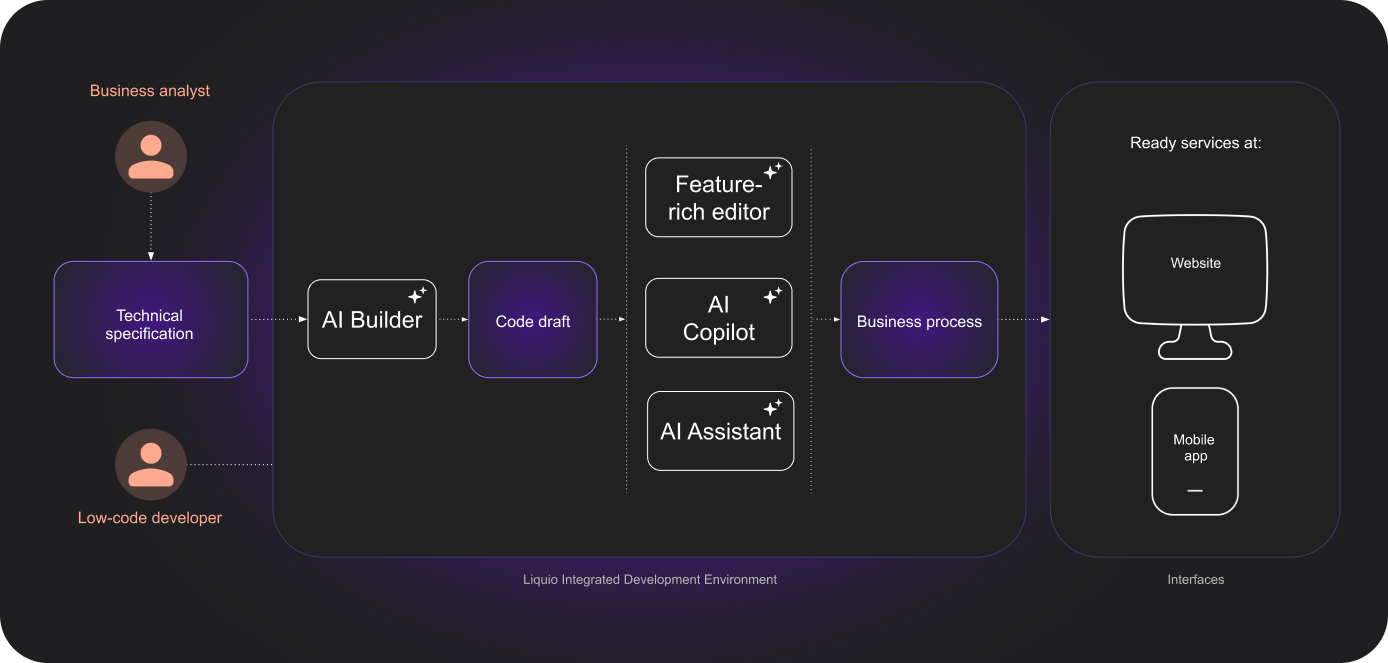
Image: AI in the Liquio ecosystem
How AI in Liquio helped implement a service with complex business logic
An important project implemented by the Kitsoft team on the Liquio platform was the online certification service for demining operators. In terms of business logic, this is one of the most complex services we have built: it includes dozens of checks, conditions, roles, and interdependencies between participants in the process.
The challenge: the classical approach would require significant resources, a large amount of manual work, and complex maintenance. Any clarification in the technical specification would trigger updates to a large number of process elements.
How we solved this thanks to AI in Liquio: AI Builder made it possible to quickly convert the technical specification into an initial BPMN structure, reducing the initial modeling stage. AI Copilot supported low-code developers during the detailing of logic — offering ready-made examples, condition templates, and configuration fragments, which accelerated the work and minimized the risk of errors.
In a service with this many dependencies, this was crucial: any change in regulations or requirements automatically affected dozens of process elements. Thanks to AI, the team could make adjustments much faster.
As a result, the team could focus on the logic of the process rather than on routine technical actions.
AI effect: development 40% faster
Performance measurements after implementing our AI tools in Liquio showed that the development speed of services by low-code developers increased by an average of 40%. This made it possible to launch services much faster, use team resources more efficiently, and make digital services accessible to users in shorter timeframes.
We believe that the symbiosis of the low-code approach and artificial intelligence will become the foundation of future digital government platforms — flexible, adaptive, and learning together with the people who build them.